Harness Credential Scoping and Permission Boundaries
Narrow agent credentials to task requirements before execution to prevent unauthorized access.
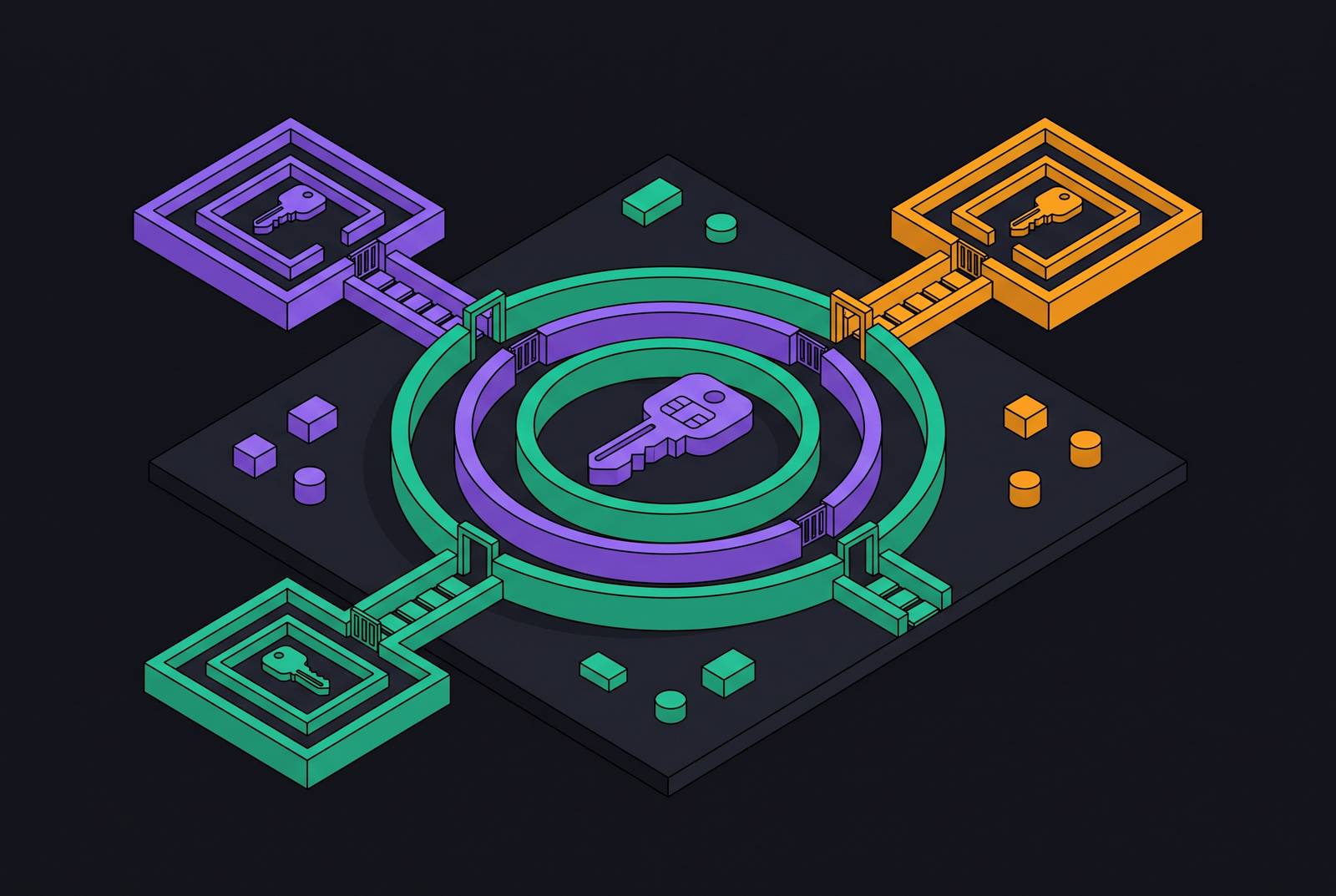
A cloud coding agent runner with a bring-your-own API key needs more than a safe place to store a model provider's API key. Running Claude Code or Codex in the cloud also requires permission boundaries that restrict what each task can reach. Harness credential scoping addresses that requirement by narrowing authority before execution, rather than leaving every permission available and relying on the agent to use it correctly.
Why static credential sets create a structural exposure for coding agents
Static provisioning gives an agent every permission its role might need, even when the task at hand needs only a few of them. Noyan's 2026 paper defines this as the task-context mismatch. Unused credentials remain exposed throughout the run. A compromised or misaligned agent can therefore exercise authority unrelated to the assignment without first obtaining a new grant.
That mismatch follows from an inherited access model. Role-based access control was designed for human principals, for whom scoping access separately for every task was operationally infeasible. A broad role envelope was the accepted compromise. Agents differ because they receive their assignments as machine-readable text before they start to run. The information needed to distinguish one task's authority from another's is available, but static provisioning does not use it.
Unit 42's September 2026 analysis of AWS AgentCore found that shell and file_operations are available in every session by default, permitting arbitrary shell commands and file reads or writes unless allowedTools is restricted. Nothing has to be misconfigured for that state to exist. AWS closed the finding as informative, citing allowedTools scoping and egress filtering as customer-side controls. The response illustrates an unsettled responsibility boundary between platforms and customers, while legacy SCM permissions add another mismatch between human-paced work and autonomous action. Harness's August 2026 announcement describes agents that open dozens of PRs in an hour, each touching hundreds of files, at any time of day.
Why vaults and perimeter controls do not close this gap
Vaults protect secrets at rest and in transit. They do not, by themselves, control a credential once it enters the agent's runtime context for use. At that point, the credential can be read, exfiltrated, or misused by a compromised or misaligned agent. Unit 42 focused its research on this move from storage to runtime. Strong storage protection and excessive in-use authority can coexist without either control failing at its intended job.
Noyan draws on Saltzer and Schroeder's least-privilege principle and capability-based security systems to place the decision about which credentials reach the agent in a trusted orchestrator or credential service. The agent cannot be its own security gate. Unlike a human principal trusted to narrow credentials when delegating, an LLM agent must not be relied on to attenuate its own authority. Removing an unnecessary credential before execution prevents its misuse and eliminates the need to recognize that misuse afterward.
Input and output filters control a different boundary. An attacker needs only one phrasing that a monitor misses, and indirect prompt injection gives the attacker repeated chances to find it. Allowlists alone are likewise best-effort controls with structural limits. A permission list without sandboxing is one bug away from full host access, while a sandbox without permission gating allows every tool call to execute silently within it. Bluebear Security's August 2026 position paper places these persistent, cross-component exposures outside the narrower category of CVE-addressable product defects, making the case for an architectural response that addresses the limits of isolated filters.
The three-layer architecture that narrows permissions to what each task actually requires
A task-based permission architecture can work by combining a role ceiling, a task-context classifier, and a policy-derived prohibition layer. The role ceiling caps what any assignment can reach. The classifier then narrows that allowance to the permissions the current task requires, while the prohibition layer blocks known-bad combinations regardless of classification. These are distinct decisions with different purposes.
Noyan's 2026 tests found that adding the task classifier to the role-based control closed 84.4% of the severity-weighted attack surface that static provisioning left open. The role control alone closed a measurable fraction, while prohibitions added marginal benefit when the classifier was operating. That result establishes the classifier's central role in the evaluated design. Prohibitions provide a fallback when classification is bypassed, although that fallback imposes real costs on legitimate tasks.
The trusted component can also remain comparatively small. A 355-million-parameter on-host encoder matched a frontier model's classification quality in the evaluation, supporting an independently deployable gate that can run in serverless infrastructure without depending on the model it governs. This separates the security decision from the agent's reasoning process. For teams building toward this architecture, the classifier is the primary task-scoping control. The prohibition layer remains a safety net whose combination rules need runtime enforcement and a fine-grained permission taxonomy.
What the tool-surface choice contributes to the permission boundary
The tool surface determines which operations an agent can express directly, but it does not settle which credentials those operations can use. That distinction separates two design questions often treated as one. A narrower surface can reduce the blast radius of a compromised run. It cannot substitute for task-granular credential scoping if the execution environment still holds broad authority. Restricting an agent to execute_code therefore complements the three-layer architecture.
Yang, Yu, and Desell's July 2026 ablation tested the competing prescriptions that integrated development environment primitives are required, bash is sufficient, or code execution is preferable. The study crossed baseline, bash-only, and code-only surfaces with two task regimes and two agents, Claude Code and Codex CLI. Code-only was cheaper than or statistically tied with its cheapest rival in three of four combinations, with pass rates invariant across surfaces. The exception was Claude Code on benchmark modification tasks, where code-only was directionally costlier because of failure-cost on doomed runs. No surface emerged as a universal choice.
For permission design, the lesson is to assess tool restrictions separately from credential availability, while recognizing that agent design and task regime jointly influence cost. Codex illustrates how an environment can address both exposure paths. Its agent phase has no internet access by default, configurable per environment. Its legacy cloud design put secrets in place during setup and removed them before the agent phase, while the current cloud design uses network secrets that a proxy injects. These boundary designs do not show that every agent should use the same tool surface or network policy.
How permission boundaries hold when running Claude Code or Codex in the cloud
Harness defaults do not provide a uniform security contract. The July 2026 study, Harness Engineering: Anatomy, Architecture, and Evolution of Coding Agents, by Paul Barbaste, Germain Vu, and colleagues documents an uneven migration of behavioral policy from prompt prose into configuration. Most harnesses do not ship a credential-scoping mechanism by default. Three of the study's original observations required substantive revision after one quarter of source diffs. A harness name alone cannot tell a team where the permission boundary lies in a deployed configuration.
This variation becomes consequential when a team runs Claude Code, Codex, and OpenCode against the same repositories. Their defaults cannot be assumed to agree. The orchestration layer, where tasks are dispatched and credentials are injected, is the place where a uniform policy can be enforced across them. Harness-agnostic workflows therefore require scoping outside the individual harnesses. For a cloud runner using the team's own API key, key handling is one criterion, while task dispatch, credential injection, and permission enforcement are separate architectural criteria.
The study found that SKILL.md skills are used more than MCP across the eleven systems it studied, but how widely they are used does not settle whether a connector can be trusted. External MCP connectors allow outside agentic services to interact with a platform using credentials that may not be task-scoped. Their authority is not automatically limited by the host harness. A consistent orchestration policy must explicitly govern each connector's trust tier and credentials rather than inheriting assumptions from whichever harness happens to dispatch the task.
Scoping credentials to the triggering user rather than a shared agent identity
Task scoping answers what an assignment requires. Identity scoping answers whose authority can legitimately support it. A shared service account recreates excessive authority at the identity layer, allowing actions under a broad account rather than the narrower permissions justified by the requester. On-behalf-of execution instead bounds an agent's actions by what the authorized user could do. That user boundary complements task classification because a task's apparent need does not itself establish the requester's right to grant access.
LangChain's September 2026 on-behalf-of implementation illustrates this separation. It stores credentials in the workspace rather than environment files or the build, resolves them at runtime by slug, and resolves user-owned connections per caller. The requesting human supplies the action's identity. This design avoids treating every caller as interchangeable behind a shared service account. It also locates identity resolution at runtime, where the particular request and its user can determine which connection applies.
That identity is already available in common dispatch workflows. A Slack mention or Linear assignment is an authorization event, and work triggered through GitHub or GitLab also has a requesting user whose identity can be kept or dropped. Harness's agent-ready SCM expresses this as delegation, allowing agents to inherit the triggering developer's permissions and developers to restrict access or merge authority to a repository, branch, or environment. Delegation also makes responsibility easier to trace. Per-run attribution that includes source, harness, model, credential, and triggering user turns agent analytics from a cost ledger into a governance record.
The agentic posture vulnerability and why permission gaps must be tracked as open records, not point-in-time findings
A correctly scoped deployment can become overprivileged as its tasks expand, integrations are added, or a harness update changes a default. Deployment approval is therefore not permanent evidence of containment. Bluebear's paper proposes the agentic posture vulnerability, or APV, as a durable record for a composed agent-control exposure. Different tasks can produce different runtime manifestations of the same underlying posture. The record ties those events to the gap that stays open, instead of treating each alert as a separate finding.
An APV gives configuration and authorization gaps a vulnerability lifecycle. It stays open until authority is narrowed, a missing control is added, risk is accepted, or closure is verified. This differs from a product defect with a discrete fix, because the exposure can span credentials, tools, orchestration, and identity without residing in one faulty component. Operationally, closure depends on whether the deployed relationship between mandate and authority has changed enough to satisfy the record's closure criteria.
The paper provides six recurring APV patterns that teams can use when auditing deployed agent configurations, both at rollout and on a schedule. Reassessment is necessary because updates and integration additions can silently reopen closed postures. One structural control is a changes-that-require-human-in-the-loop tier for changes to permission boundaries, network access, credential handling, deployment behavior, or human-review requirements. Approval applies before those configuration changes activate. The concrete deployment action is to establish a posture record for each deployed agent configuration and define closure criteria before deployment, so that future changes are judged against an explicit boundary independently of past approval.
Sources
- A Vault with a Heap-View: The Uncomfortable Space Between AgentCore Harness and Identity
- Empirical Evaluation of Task-Based Permission Scoping Architecture for AI Agents
- When Does Restricting a Coding Agent to execute_code Help? A Regime $\times$ Agent-Design Ablation
- The Vulnerability With No CVE: Managing Persistent Gaps Between Mandate and Authority in AI Coding Agents
- Harness Engineering: Anatomy, Architecture, and Evolution of Coding Agents -- A Source-Code Study of Eleven Systems