Cursor vs Claude Code for Team-Wide Agent Deployment
Most production teams run both tools, routing work by task type rather than picking one.
Asking whether Cursor or Claude Code is "better" misses the actual decision in front of an engineering team. Engineers must decide where they sit in the implementation loop, and how much of that loop they are willing to hand to a machine that acts without waiting for permission at each step.
Cursor is an AI-native IDE built as a VS Code fork, where a human drives and the AI only assists inline. Claude Code is an agentic coding tool, available in the terminal, in a desktop app, and on the web, where the engineer briefs a goal and the agent drives execution across multiple files on its own. That distinction holds across every serious account of how the two tools behave, and it is foundational: nearly every downstream tradeoff in speed, review load, and infrastructure traces back to it. Cursor's working model amounts to VS Code with the AI treated as a first-class citizen: engineers see every diff before it lands, accept or reject changes inline, and stay in the loop at each step of the work. Claude Code's working model asks the engineer to describe the outcome and let the agent get there: it plans the approach, edits across dozens of files, runs tests, and reports back only when there is something to review.
For a team deciding how to deploy either tool across an engineering organization, that split determines the adoption curve, the infrastructure the team needs to support it, how much review capacity gets consumed afterward, and, most importantly, how much of the actual coding work engineers hand off versus perform themselves. Everything that follows in this piece, the mechanics, the adoption data, the review bottleneck, the integrations, only makes sense once that frame is in place.
Autonomy, context, and multi-file work across the two tools
The performance differences between Cursor and Claude Code are measurable on the dimensions that matter for team-scale work: how much a tool can do without supervision, how well it retains context across a large codebase, and what a given task costs in tokens. Those differences trace directly back to how each tool is built.
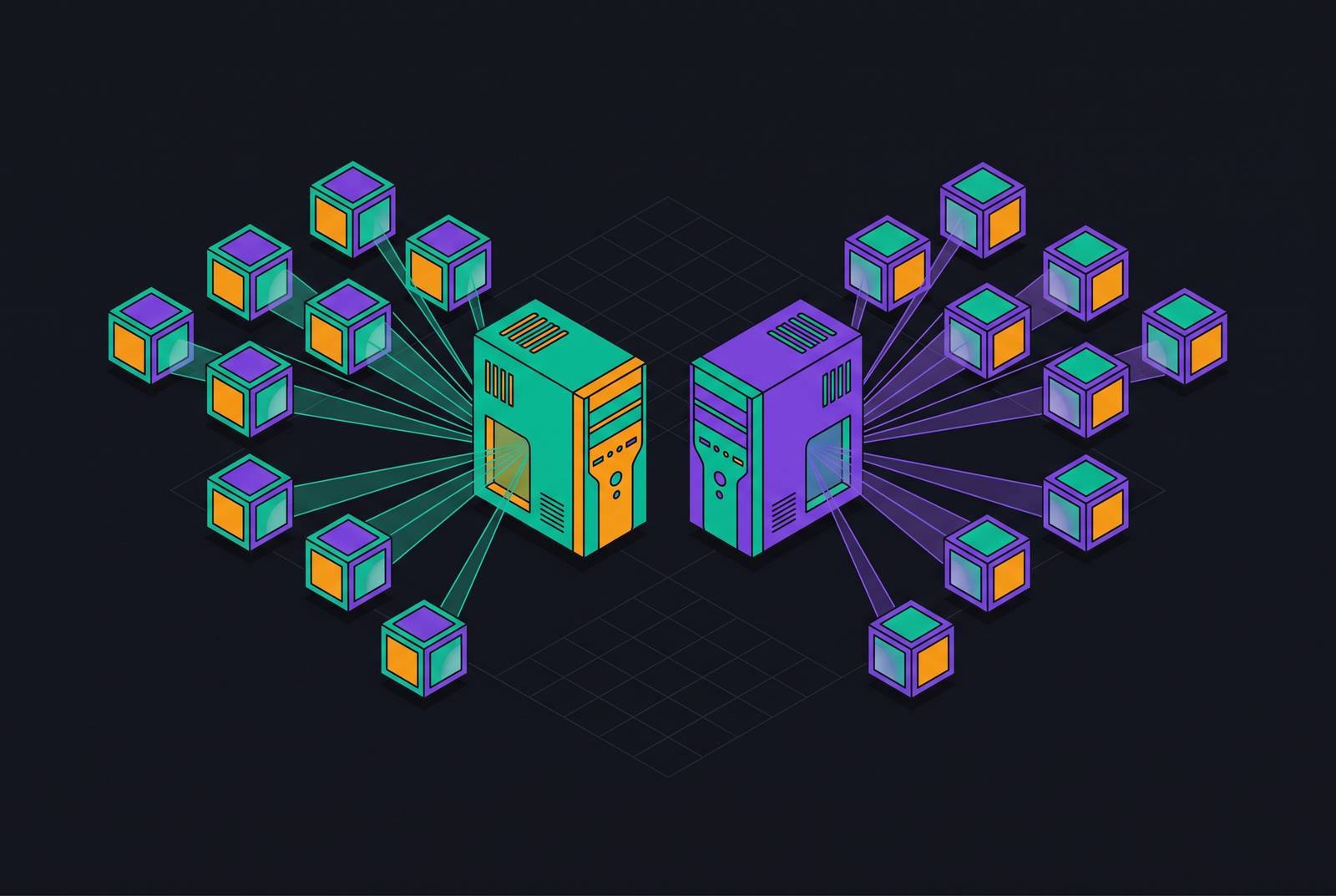
Cursor re-sends context at each step of a session to keep its interactive speed high. That architecture is what makes inline suggestions and instant diffs feel responsive, but it means the tool is reconstructing its understanding of the codebase repeatedly rather than holding it once. Claude Code instead loads files once into a large context window, and it works from that single read. So Claude Code has a real edge on large-repo comprehension and on refactors that touch many files at once, because the agent never pays a re-loading cost to recall something it already saw. Cursor's weak spot appears in the inverse case: once a change spans many files, the interactive, diff-by-diff model that makes it fast for small edits starts to work against it. Claude Code has its own failure mode in the opposite direction. Claude Code can drift on small, visual UI tweaks, work where a pixel-level diff and immediate visual feedback matter more than broad codebase context, and where an agent operating from a plan rather than a live preview is more likely to miss the mark.
Benchmark comparisons between the two tools need a caveat that is easy to overlook. Because the underlying model, Opus 5.5, runs inside both products, any benchmark result is measuring the model's capability, not a genuine product-versus-product contest, a point NeuralTrust makes explicitly in its own analysis. No public benchmark currently pits the two agent products against each other using the same model to isolate the product layer from the model layer. What the available benchmarks establish, then, is task fit rather than a winner: which category of work, interactive and visual versus autonomous and broad, plays to each tool's architecture.
What the adoption shift from Cursor to Claude Code signals
If the mechanics explain why the two tools behave differently, adoption data shows how engineering teams are actually resolving that difference in practice. The signal is clear: teams are shifting toward agent-first workflows for team-scale deployment.
The JetBrains AI coding agent survey, which covered more than 15,000 developers, found that Claude Code's workplace use more than doubled between January and mid-2026, while Cursor's usage fell over the same period. That is a reversal, and reversals of that size in a developer survey of that scale are rare enough to treat as a genuine market signal rather than noise.
The natural misreading of that data is to conclude Cursor lost the market. A more accurate reading is that the category of autonomous agent work grew faster than IDE-assisted editing did, and that growth pulled developer attention toward Claude Code without displacing what Cursor does well. Teams adding Claude Code are doing so on top of their existing Cursor usage, not tearing it out. That distinction matters for anyone making a procurement or rollout decision: the adoption curve is evidence of where agent-native work is expanding. It sets up the practical pattern that most production teams have already converged on: running both tools and routing work between them by task type.
Why most production teams run both tools, and how they divide the work
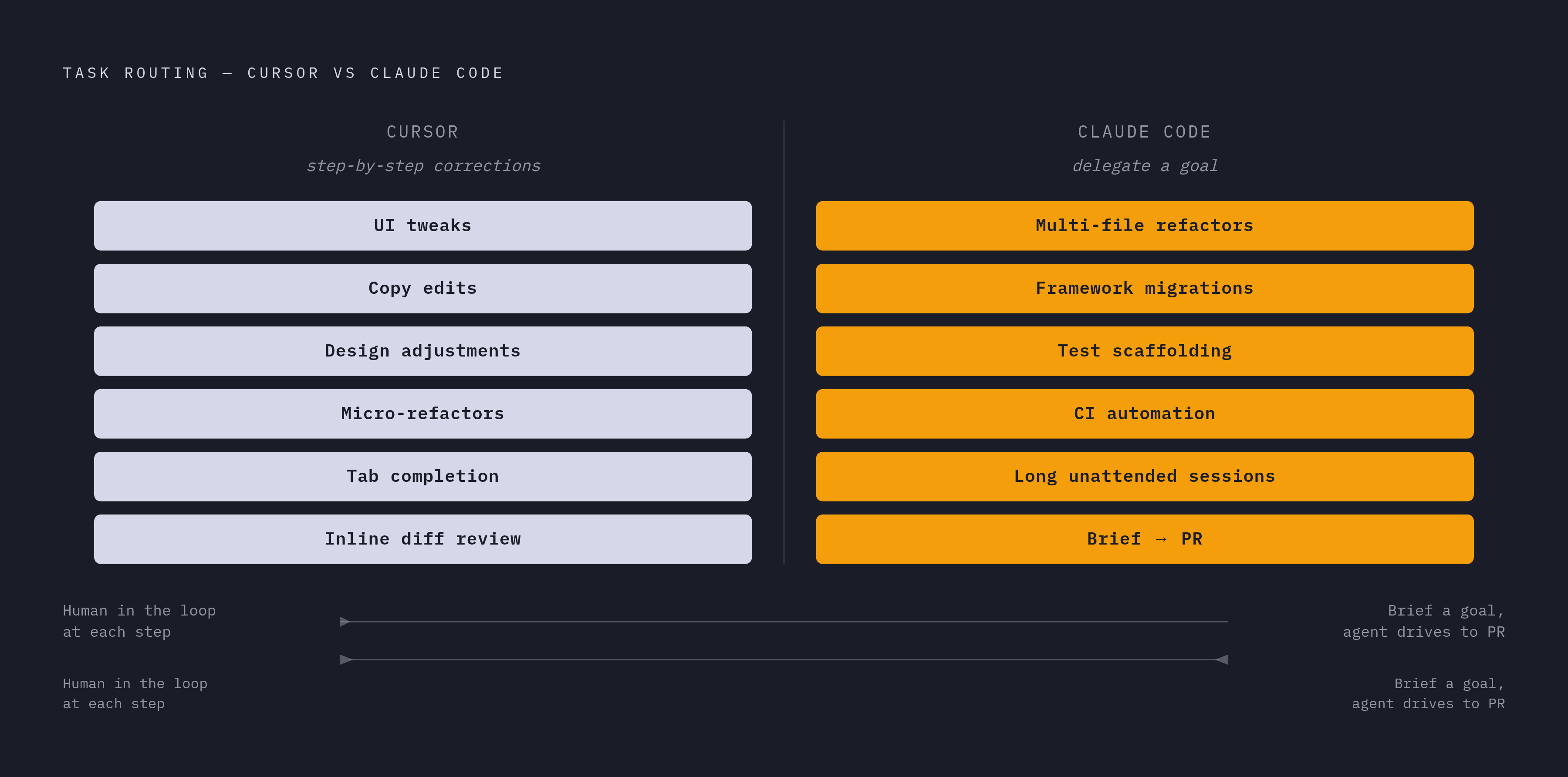
The task partition between Cursor and Claude Code is consistent enough across engineering organizations that it amounts to an informal standard. Cursor handles the work that benefits from constant human presence: UI work, design tweaks, copy edits, micro-refactors, tab completion, and anything where an engineer wants to see an inline diff and accept or reject it in the moment. That category of work resembles detective work more than construction work: small, deliberate corrections made one at a time, with a human checking each one as it happens.
Claude Code handles the work that benefits from delegation at the level of a goal rather than a line: multi-file refactors, framework migrations, test scaffolding, CI automation, and long sessions that can run unattended overnight. Any task where briefing an agent and reviewing the resulting pull request is faster than staying inside the editor for the duration of the work is a candidate for Claude Code.
That routing logic is what separates a team that has genuinely adopted agentic coding from one that has merely installed it. Running Claude Code alongside Cursor is now the dominant real-world configuration, not an edge case, and the productivity gains teams report come from matching task type to tool, not from picking one tool and forcing every task through it. For teams moving toward cloud agent workflows, this same control-model distinction also shapes infrastructure decisions: whether agents run locally inside an IDE, or inside isolated cloud environments built to support them. Cloud agent platforms run coding agents in sandboxed environments that come pre-configured with a team's codebase and tooling, which shifts the operational decision from which IDE harness the team standardizes on into "which agent model and orchestration layer work together across the team's actual task mix?" Once a team is routing tasks between two tools rather than committing to one, that orchestration layer becomes the thing that actually needs managing.
The review bottleneck that faster generation creates
Team-wide agent adoption creates a structural problem that did not exist at this scale before agents could generate code this fast: a review bottleneck. When agents generate code faster, pull request volume rises substantially, and review time rises with it, so you lose a meaningful share of the speed you gained from faster generation to the review work that follows.
That has a direct implication for any team planning a rollout. Generation speed was never the actual constraint on shipping software; review capacity and verification quality always were, and agentic tools made that fact visible in pull request volume and review queues faster than it used to appear. If a team deploys Cursor or Claude Code across its engineers without also building out a review workflow that can absorb the resulting pull request volume, it has not solved its throughput problem. It is relocating the bottleneck from the writing stage to the reviewing stage, where it is often harder to see and harder to staff for.
The two tools are not equally equipped to help with that problem today. Cursor's Bugbot covers more repository platforms for automated review, supporting GitHub, GitLab, Bitbucket, and Azure DevOps, though Bitbucket Cloud and Azure DevOps remain public betas, and Azure DevOps currently lacks Autofix along with having limited comment-command support. Claude Code Review, by comparison, is GitHub-only at this point. For a team whose repositories live entirely on GitHub, that gap is irrelevant. For a team running GitLab, Bitbucket, or Azure DevOps anywhere in its stack, it is a real constraint on which review tooling can be deployed alongside which coding agent, and it is one more reason the choice between these tools, or the decision to run both, depends on the infrastructure a team already has rather than on either product's generation quality alone.
How each tool integrates into existing engineering workflows
The integration picture is uneven in a specific and predictable direction. Claude Code's integrations run deeper on the side of agent delegation, so you can hand off full tasks from wherever you already work. Cursor's integrations run broader on the side of review and repository platform coverage. Neither tool covers the full span of what a production engineering org actually runs, and you face that gap as the live operational constraint whether you pick one tool or combine both.
On Slack, if you use Claude Code, you can @mention Claude directly inside a thread to delegate a full coding task without leaving the conversation. Claude reads the thread's context, picks the right repository, starts a coding session, posts progress updates back into the thread, and presents a "Create PR" button once the work is ready for a human to open the pull request. That integration currently supports only GitHub repositories: the documentation states, "GitHub only: Currently supports repositories on GitHub. Cursor has a comparable Slack-native delegation integration of its own, documented at cursor.com/docs/integrations/slack: you can mention Cursor's cloud agents from a Slack thread and get status updates as the agent works toward a pull request.
Repository platform support shows the same asymmetry from the other direction. Claude Code shipped GitLab support across two back-to-back releases on August 13 and 14, 2026, making GitLab a first-class citizen alongside GitHub across worktree handling, agent view, and the plugin marketplace. GitLab also maintains a .gitlab-ci.yml job that runs Claude Code inside its own CI pipeline, currently in beta, and it demands more manual setup than the first-party GitHub Actions integration that GitHub users get out of the box. Running agents at this kind of scale across a team rather than one engineer at a time raises token economics and context efficiency as a sharper consideration. When Claude Code or Cursor runs inside a dedicated cloud environment rather than on a single developer's machine, the cost of re-sending context compounds across dozens of concurrent agent sessions, so Claude Code's single-read context model carries more weight for team-wide deployment than it would for an individual user running one session at a time.
Where agents run matters as much as which agent runs. A centralized cloud platform that supports multiple harnesses and models lets a team trigger the right agent for a given job directly from the tools it already uses, such as Slack or Linear, so engineers don't have to switch between an IDE and a separate agent interface every time the task type changes, Replicas, for instance, runs both Cursor and Claude Code in isolated cloud VMs triggered from those same sources. For engineering organizations working through a team-wide rollout, that orchestration layer is what makes the hybrid stack described earlier function as one coherent workflow instead of two disconnected tools that happen to share a codebase.